
Your blog post
Blog post description.
7/7/20263 min read
Augmented Engineering: The Business Case Beyond the Hype
Artificial intelligence has become one of the most discussed topics in engineering. Every week brings another impressive demonstration, another product launch, or another promise of transforming product development.
For engineering leaders, however, the real question is much simpler.
What measurable business value does AI actually deliver?
Technology demonstrations are easy to create. Delivering consistent results across complex engineering projects is much harder.
The conversation needs to move beyond novelty and focus on outcomes that matter to every engineering organisation: higher throughput, less rework, and better use of experienced engineering talent.
Looking Beyond the AI Hype
Engineering is not an environment where mistakes can be accepted as part of experimentation.
Every requirement, calculation, design decision and validation activity carries downstream consequences. A missed requirement at project intake can become an expensive redesign months later, affecting schedules, manufacturing readiness and customer confidence.
That is why engineering leaders tend to be cautious.
The question is never whether AI is impressive.
The question is whether it improves project delivery without introducing additional risk.
The answer lies in measuring business outcomes rather than technical capabilities.
Three Areas Where the Value Becomes Visible
The strongest business case for augmented engineering is not built on theoretical productivity gains. It is built on measurable improvements across the engineering lifecycle.
1. Reducing Costly Rework
One of the most expensive problems in equipment development is discovering requirement gaps after detailed design has already begun.
A missing requirement at the start of the project may seem minor, but correcting it later often affects multiple engineering disciplines, documentation, testing plans and manufacturing preparation.
By identifying inconsistencies, missing information and traceability issues during the requirements stage, engineering teams resolve problems when they are still inexpensive to fix.
Preventing a single major redesign can often justify the investment in improving the front end of engineering.
2. Increasing Engineering Throughput
Many engineering organisations are not limited by customer demand.
They are limited by engineering capacity.
Projects compete for the attention of the same experienced engineers, creating queues that delay programme starts and extend delivery schedules.
When requirements development becomes faster and more structured, projects begin earlier.
The same engineering team can support more programmes without increasing headcount, allowing the organisation to grow capacity while maintaining quality.
This is one of the most significant drivers of augmented engineering ROI.
3. Making Better Use of Senior Engineers
Experienced engineers are among the most valuable assets in any engineering organisation.
Unfortunately, many spend a significant portion of their time reviewing documents, checking traceability, validating compliance and performing repetitive verification tasks.
These activities remain essential, but they are not where engineering expertise creates the greatest value.
By reducing manual checking and documentation effort, senior engineers can focus on system architecture, technical problem solving, mentoring younger engineers and engaging directly with customers.
That shift improves both productivity and job satisfaction, making it easier to retain highly experienced talent in an increasingly competitive market.
Why Augmented Engineering Matters More Than Full Automation
There is an important distinction between automation and augmentation.
Automation attempts to remove people from the process.
Augmentation strengthens the capabilities of the people already performing the work.
At NeuroAxis, this principle guides the entire platform.
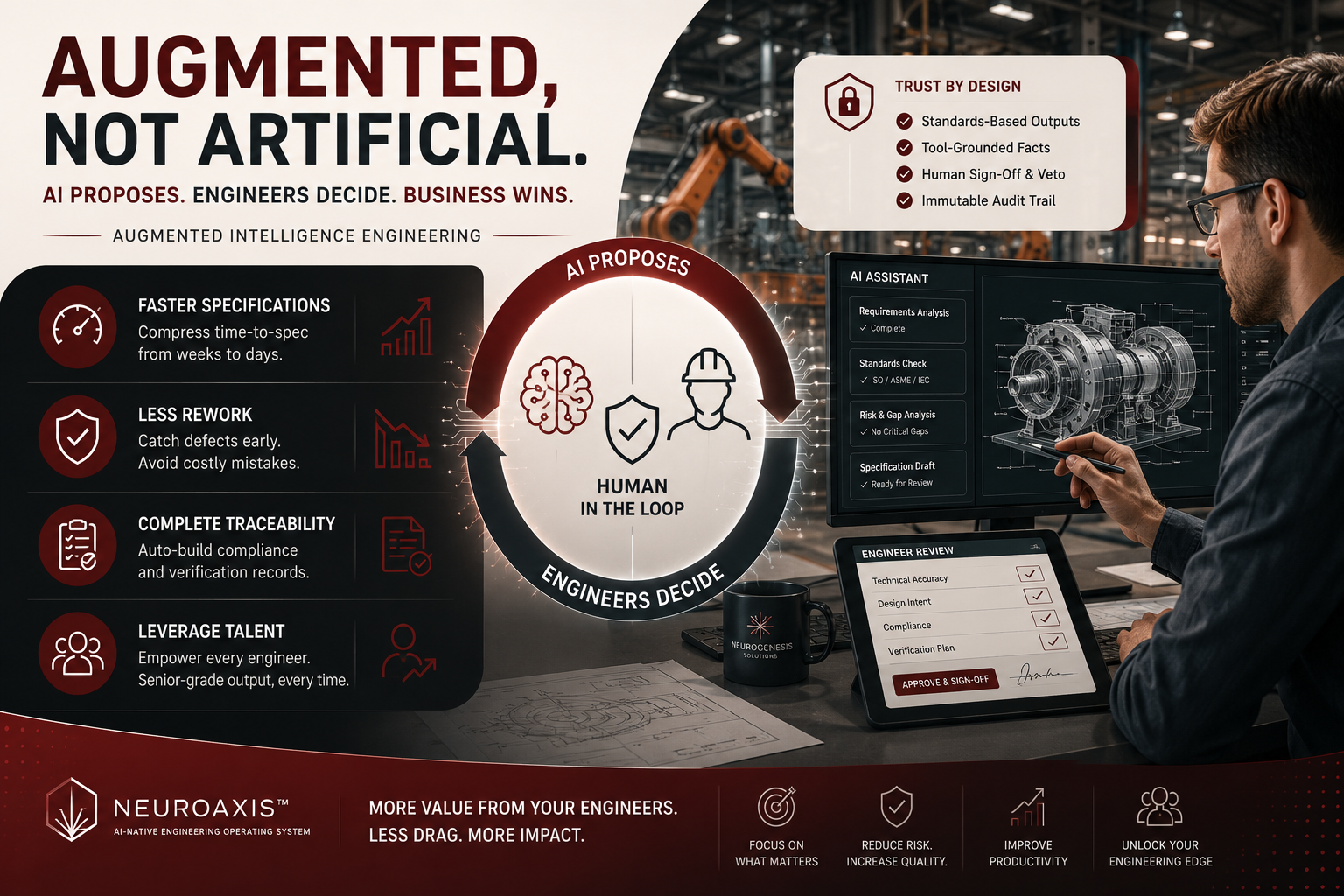
AI assists by drafting requirements, checking consistency, maintaining traceability and identifying potential issues.
The engineer reviews every recommendation, applies professional judgement and makes the final decision.
This human-in-the-loop approach is not a limitation.
It is what builds confidence.
Engineering decisions remain accountable, transparent and aligned with established standards while benefiting from AI-assisted speed and consistency.
That combination creates trust that extends beyond a successful demonstration into everyday engineering practice.
Measure Success Using Your Own Data
Every engineering organisation is different.
Project complexity varies.
Processes differ.
Customer expectations evolve.
For that reason, the most credible way to evaluate AI is not through industry averages or marketing claims.
It is through your own engineering data.
A focused pilot can provide meaningful measurements such as:
Time taken to produce a System Requirements Document (SRD)
Requirement defects identified during project intake
Manual traceability effort eliminated
Engineering hours redirected towards higher-value work
These measurements provide a practical business case based on actual operational performance rather than estimated benefits.
The Future of Engineering Productivity
Artificial intelligence should not become another tool that engineers are expected to learn simply because it is new.
It should solve real engineering problems.
The organisations that achieve lasting value will be those that deploy AI where it improves decision-making, strengthens engineering quality and allows experienced professionals to focus on innovation rather than administration.
That is the true promise of augmented engineering.
Not replacing engineers, but enabling engineering teams to deliver more with the expertise they already possess.
Discover Your Own ROI
Every engineering organisation has different processes, challenges and opportunities.
The best way to understand the value of augmented engineering is to measure it using your own projects.
The NeuroAxis ROI View demonstrates where engineering time is spent today, where improvements can be achieved, and how those improvements translate into measurable business outcomes.
Book a pilot scoping session and discover your own augmented engineering ROI using real engineering requirements and real operational data.